November 06, 2026·7 min read
I asked AI agents to build Ezekiel's wheels, two ways
A visual study of Ezekiel 1 made by AI agents: an interactive Three.js console and a cinematic Blender scene, with the numbers for each, what broke along the way, and why this does not replace an artist.
Ezekiel 1 describes a vision that is hard to draw: a wheel in the midst of a wheel, with high rims full of eyes, that moved without turning. I wanted to see what a coding agent does when the text is the only brief. What it builds, where it invents, where it fails.
This is a study, not sacred art, and it does not replace the work of an artist, who would bring far more depth, sensitivity and faith to this passage. What I measured here was the tool, not the vision.
I built the same scene two ways, with AI agents (Claude Code) under my direction and review, and cut the two together into a 42-second film.
The text as the spec
Every shape in the scene traces back to a verse, not to imagination:
- a wheel beside each living creature, four wheels in all (1:15)
- "a wheel in the midst of a wheel" (1:16)
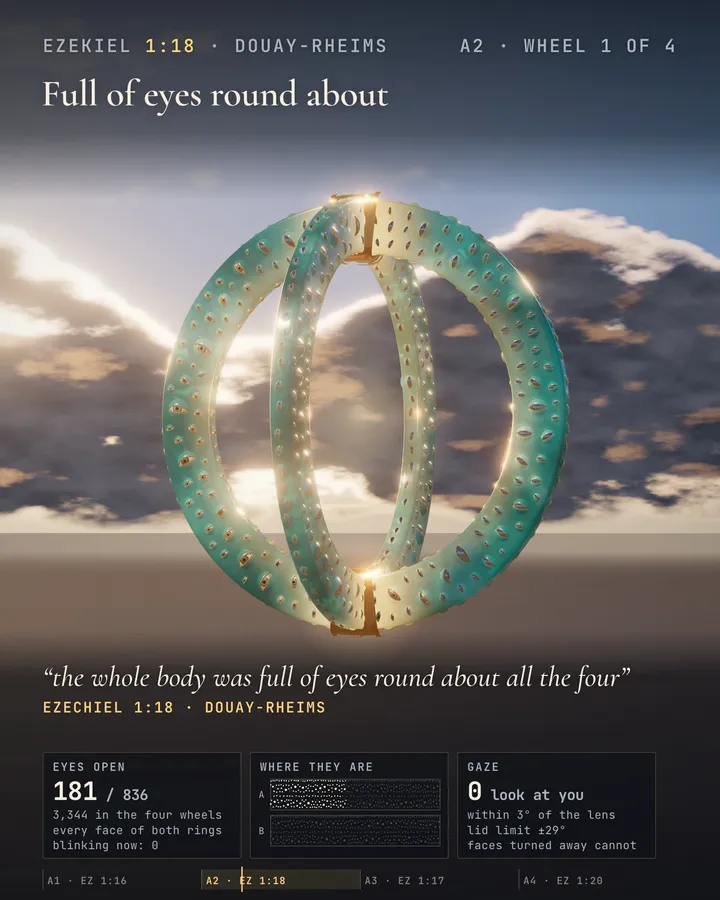
- the wheels had "a size, and a height, and a dreadful appearance," and the whole body was "full of eyes round about all the four" (1:18)
- they went by their four parts, and "turned not when they went" (1:17)
- "the spirit of life was in the wheels" (1:20)
- the prophet falls on his face and is told to stand (1:28 to 2:1)
What does not come from the text I marked as my choice. Crossing two rings at right angles is the common reading of "a wheel in the midst of a wheel", but the text gives no angle. The eye count, 836 per wheel, is mine. And the rings spinning on their own axes is my interpretation, drawn from 1:20: the text never says they spin.
Two ways to build it
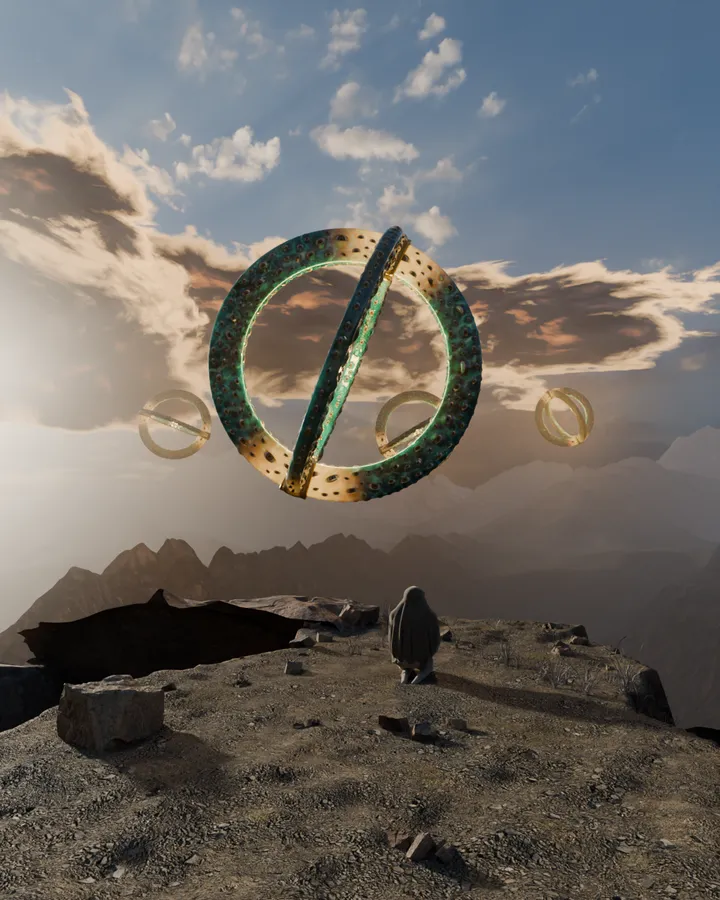
The first is a Three.js console, built with the teardown skill (MIT). One model drives the video, the interactive page and every number on screen, so nothing shown can disagree with the motion. The second is a Blender scene with Cycles, using free Poly Haven skies and terrain (CC0).
- Console (Three.js): 36 min of active build; the 16 s film was captured in 82 s; output is a 10.8 MB film plus an 851 KB interactive page; 836 eyes per wheel.
- Cinema (Blender): 504 frames, 4.13 h of render (5 h 19 min wall); 21 s film, not interactive; 836 eyes per wheel; active build time was not logged consistently.
The console explains and lets you poke at it. The cinema convinces the eye: the sky, the light, the scale. Neither does the other's job, which is why I cut the two together.
What I used
- The agents: Claude Code, with one agent per track (the console, the Blender scene, the film assembly, the research), and me deciding and reviewing. Each agent logged times, attempts and failures in a metrics file, which is where this post's numbers come from.
- The console: Three.js, with the teardown skill. The 836 eyes per wheel are instances, the page ships as a single offline HTML file of 851 KB, and the film is captured frame by frame with Playwright and ffmpeg. The score comes from a pure-Python synthesis engine, the same one teardown uses.
- The scene: Blender 5.2.3 with Cycles on Metal, on an Apple M4 with 16 GB, with OIDN denoising. The whole scene is built by Python script, with nothing modeled by hand, and the man's mantle is a cloth simulation. Frames render at 75% resolution with 16 samples at most, then scale up to 1080×1350 with ffmpeg.
- The assets: skies, terrain and textures from Poly Haven (CC0). The caption fonts are Cormorant Garamond and JetBrains Mono (SIL OFL).
- The assembly: captions are rendered as images in Chromium via Playwright and composited with ffmpeg. Sound is normalized to −14 LUFS with two-pass
loudnorm. - The text: Douay-Rheims, from drbo.org.
What broke along the way
The errors were the useful part.
- The storm cloud rendered as a flat brown blob. Three tries later it became a painted backdrop with gold edges. It works because the camera is fixed; with a moving camera it would not.
- The god rays only showed up with invisible geometry. Painted light was not enough. What worked was a perforated screen outside the frame that casts real shadows into the haze.
- The render hung with no error. A Blender chunk stalled under memory pressure, with swap at 9 GB, and cost about 50 minutes. Running two Blenders at once hung both. Since then: one process at a time, 8-frame chunks, resumable, with a watchdog.
- The 222 s per frame estimate was wrong. The time was not going into pixels, it was going into rebuilding the scene every frame. Making the distant terrain coarser, with no visible difference, took a frame from about 55 s to about 26 s.
- The prostrate man still looks like a spread cloth. I redid the shot once and it did not get where I wanted. It is in the film as is.
- The eyes convince up close; from far away they turn into gold dots. And the crystal still looks painted, not lit from within.

What I did not do
I did not generate a version with an AI video model, because I decided not to spend on it for this project. I left a prompt pack ready for anyone who wants to run it in a video tool, with the five shots and the first frames, but it was never run. I would rather say that than let it look like the comparison has three sides.
It is also not a controlled experiment: different agents built each version, sharing the same GPU and machine load at different times, so the timings may be inflated, and both paused on usage limits.
I reviewed everything on my phone, with the videos in media-viewer, the same one I use to watch what my agents produce.
Credits
- The teardown skill by elvarofficial (MIT)
- Scripture: Douay-Rheims Bible (public domain), Ezekiel 1 and 2
- Skies, terrain and textures: Poly Haven (CC0)
If you are a Catholic artist and this passage moves you, I would love to see what you would do with Ezekiel 1, and to credit you for it.
- Renan
Related reading
A skill that picks between Three.js, Blender and AI video, and keeps itself honest
I built the same scene two ways and turned what I learned into an open-source Claude Code skill: it picks the tool by the job, gives the render and assembly recipes, and can tell what was measured from what is only research.
My coding agent now narrates, scores and reviews the video of what it built
agentic-media-kit got sound: a voiceover, a score composed for the cut, synced subtitles and cuts on the beat. Plus a second agent, with no context, that reviews every frame before I do. The video in this post was made that way.
My coding agent now records what it built
I code from my phone: T3 Code drives the agents, they run on a Railway devbox, and I get a "Done". What was missing was seeing the UI. agentic-media-kit closes that loop: the agent records the app, cuts a Reel, and hands me a link I open on my phone.